Magic Gets the First Try. Progression Gets the Second Week.
Most AI products have a wow moment. Very few have a reason to come back tomorrow.

Most AI products have magic. Very few have progression.
GenAI has solved the first session. Type a messy prompt, and you get clean code, a sharp summary, or a useful analysis in seconds. That response — fast, clean, better than you expected — is a genuine wow moment. The category earned it. For a significant window of time, new AI tools won their early user base almost entirely on first-session delivery.
But session four is a different problem.
The magic decay curve
The trajectory of a user’s relationship with a new AI tool follows a consistent path. It is not flat. It is not a cliff. It is a curve that most product teams can see in their data if they’re looking at the right segmentation.
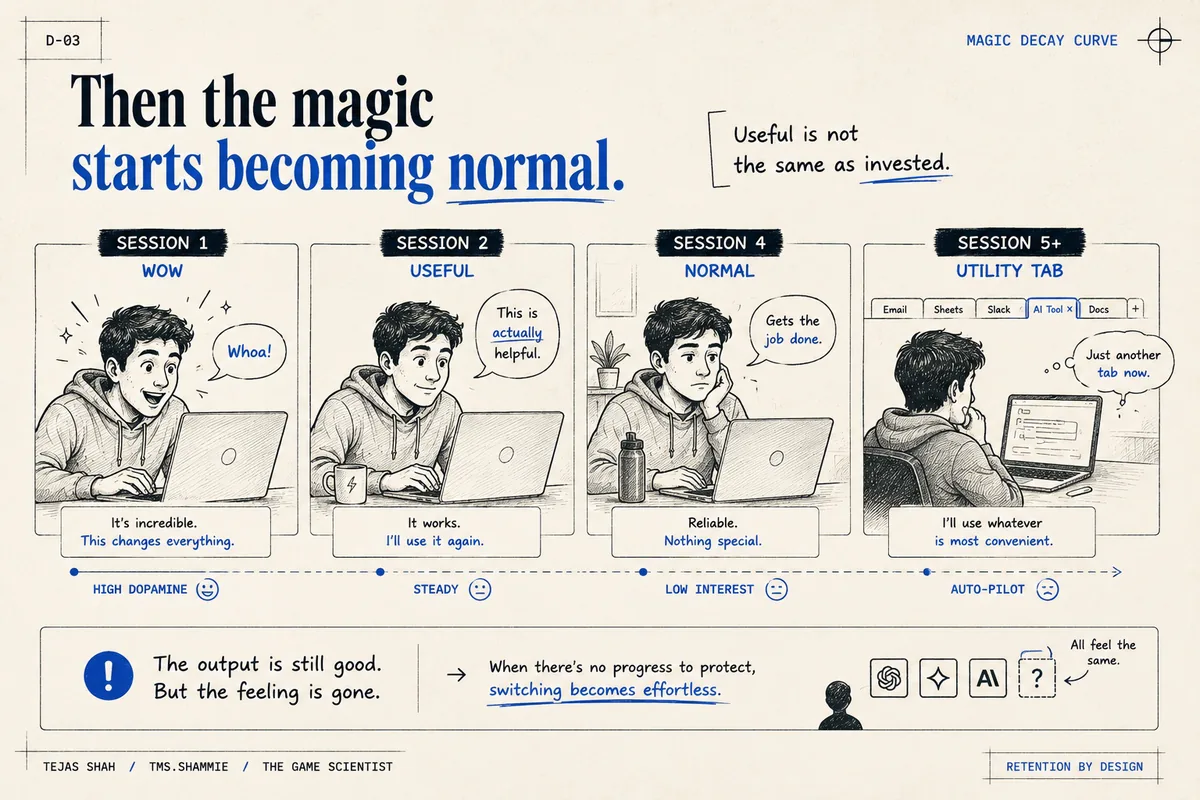
WOW — the first session delivers something surprising. The output quality exceeds what the user expected from a typed prompt. The experience feels like unlocking a new capability. Activation is high.
USEFUL — by sessions two and three, the novelty has settled. The user understands the capability. They’re using the tool deliberately, reaching for it when a specific task calls for it. The wow is gone, but the utility is real.
NORMAL — the tool has become part of the workflow. It’s no longer surprising. It no longer gets mentioned in conversation. It’s just there. This is a success state for adoption, but a warning sign for retention: “normal” is what a tool is when it could be replaced without feeling like a loss.
UTILITY TAB — by month two or three, for many users, the tool has become one tab in the browser among several. Still used when needed. Genuinely capable. But no longer something the user is invested in. The tool serves the current request. It does not accumulate anything on the user’s behalf. Switching would be inconvenient, not costly.
The insight from fifteen years of mobile gaming data is that this decay curve is not inevitable. It is the default state for products that optimize for magic and treat the experience as complete at the output. Progression infrastructure is what intercepts the curve before it reaches “utility tab.”
What games figured out
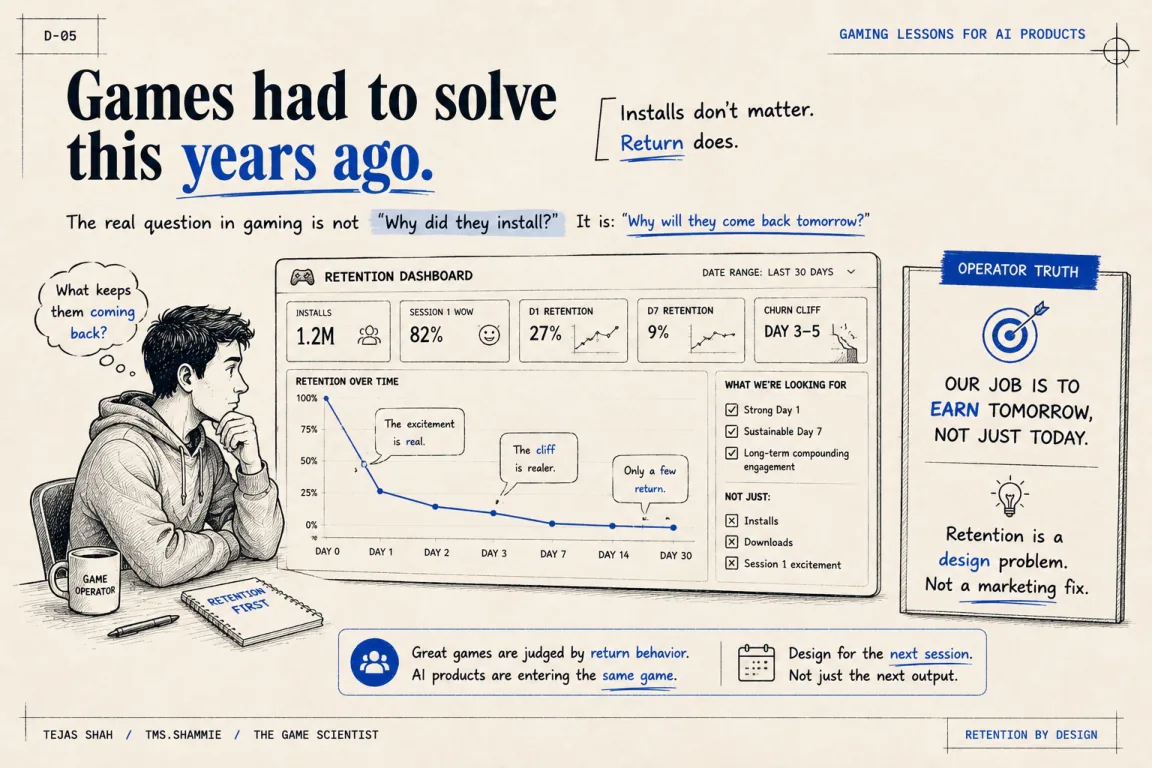
Mobile gaming has been sitting with the “why come back tomorrow” question for fifteen years, and it produced a workable answer.
The insight is not complicated: utility gets the first session. It does not create a reason to return. What creates a reason to return is investment — specifically, the feeling that what you built inside the product has value that would be lost if you stopped.
Games solve this through a system of missions, mastery, unlocks, visible progress, inventory, status, and social positioning. These structures are not decoration. They answer the “why come back tomorrow” question at every step of the retention curve. A player at day one has a reason to return that is different from the one at day thirty, and the game has designed both.
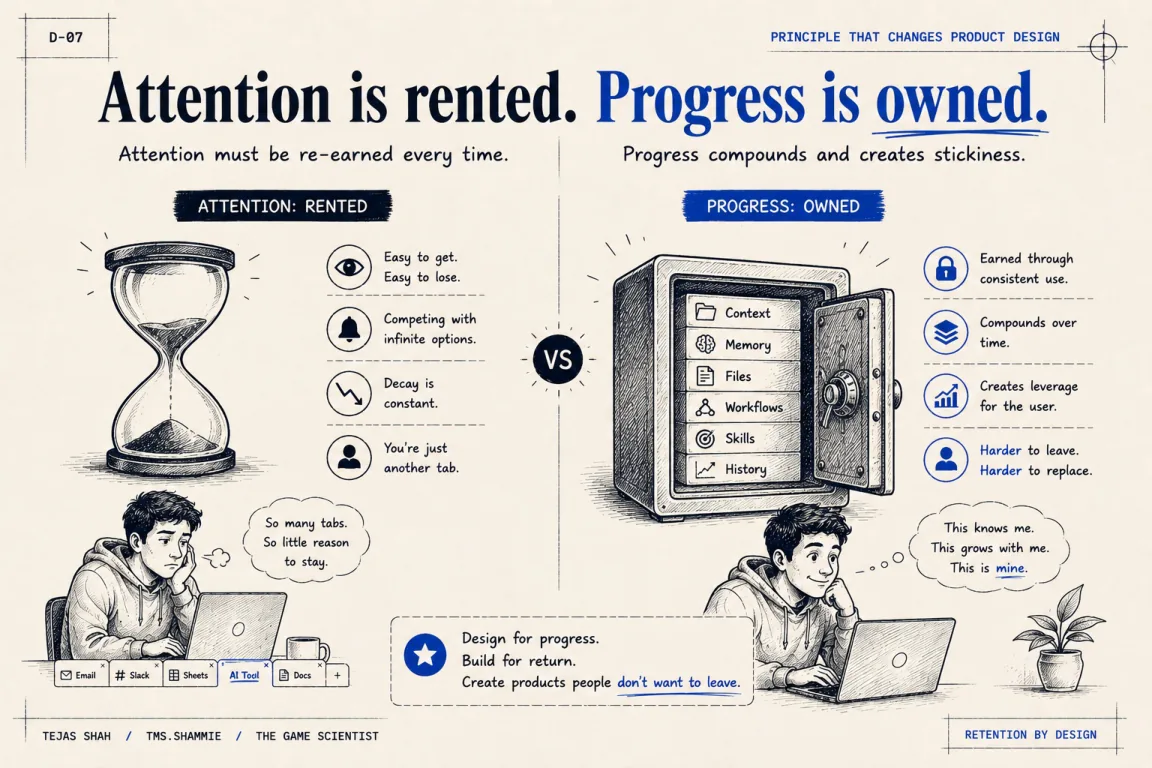
The rule the games industry derived from this is simple: attention is rented; progress is owned. A player who is entertained by a game does not necessarily return. A player who is seven levels into a progression system, has two rare items in inventory, and has an active battle pass returns because they have something to lose.
Retention is a design problem, not a marketing fix. You cannot push-notify or re-engagement-campaign your way out of a product that has no accumulation to offer. The behavior either compounds inside the product or it doesn’t.
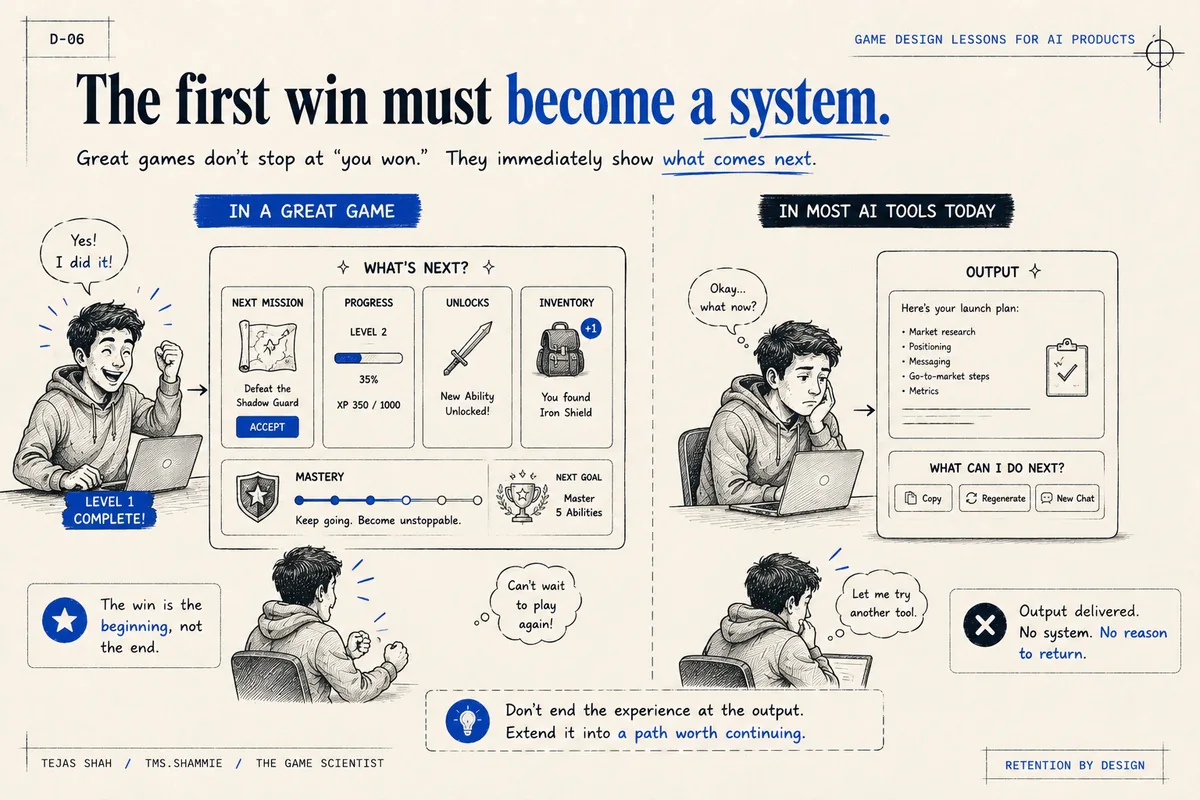
Why most AI products stop at capability
AI product teams, understandably, have focused on output quality. The benchmark for most tools is whether the thing it produces is good. Clean code, accurate summary, useful analysis. This is correct and necessary, but it answers a different question than “will the user be here in six weeks.”
The design error is in treating the tool as stateless. The user comes in, generates output, leaves. Don’t end the experience at the output. There is no accumulation, no investment, nothing that makes this instance of the tool more valuable than any other instance, more valuable than a competitor’s tool, or more valuable at month three than at month one.
Games understood that the accumulation itself is the moat. Not the capability — the accumulated state. The character you built. The progress you earned. The history the game holds on your behalf.
What progression infrastructure looks like outside of games
The product that has moved furthest on this is ChatGPT’s Projects and persistent memory architecture. To understand how significant the shift is, it helps to trace how the product has evolved stage by stage.
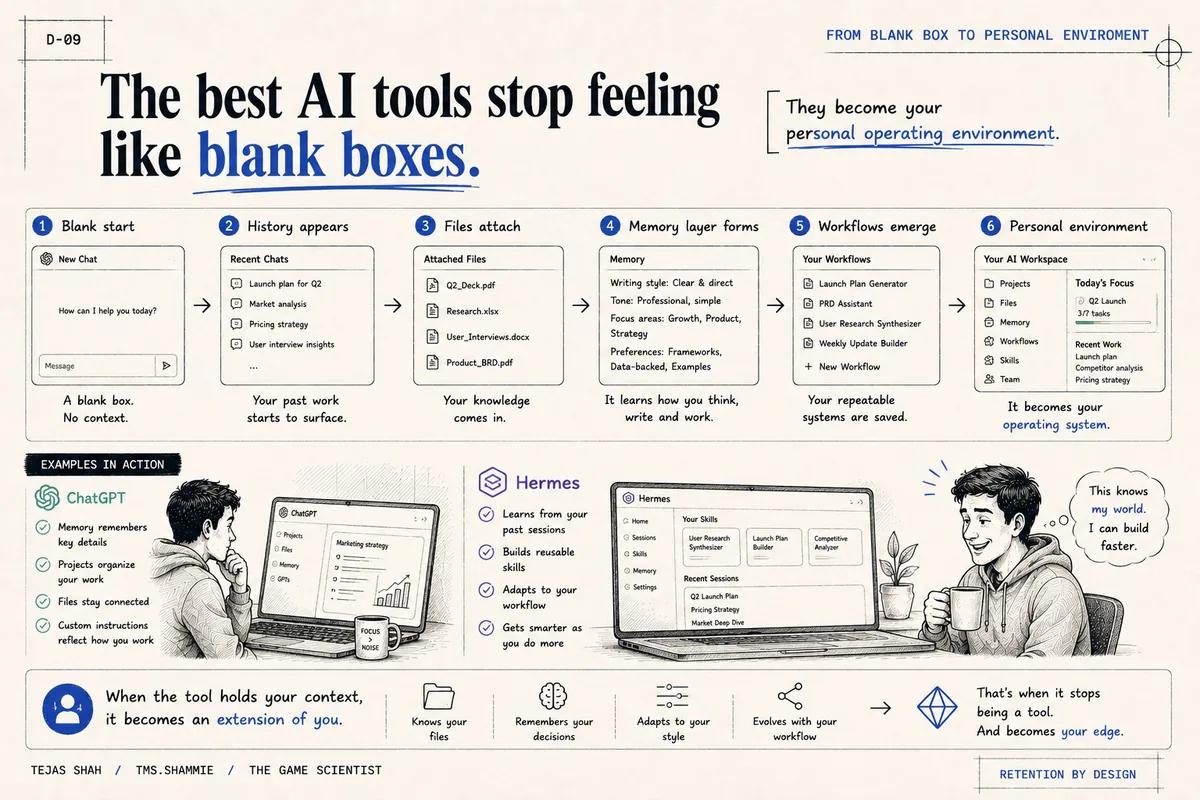
Stage one was a blank box: a text field, a submit button, and a response. No history. No context. Clean slate every session. Stage two added session memory: conversations were saved, searchable, revisitable. Better, but still stateless between sessions. Stage three added custom instructions: users could set persistent preferences and context that shaped outputs across sessions. The product started behaving as if it knew the user. Stage four added Projects: organized workspaces where files, instructions, and conversation history existed in one persistent environment. Stage five added deep memory: the ability to recall context from past conversations and apply it to new ones. Stage six is the emerging state — a personalized environment where the blank box has been replaced by something closer to a working partner with documented knowledge of how you operate, what you’re building, and what you’ve already worked through.
Each stage increases the switching cost. In stage one, switching tools is trivially easy — you lose nothing. In stage six, switching means losing what is effectively a vault: Context (how the tool understands your domain and working style), Memory (accumulated knowledge from past sessions), Files (the document history embedded in Projects), Workflows (the structured approaches the tool has learned you prefer), Skills (the specialized task patterns that have been refined with use), and History (the record of decisions, drafts, and outputs that inform new work). The user who has filled this vault is not comparing AI tools on capability anymore. They’re calculating what they’d lose by leaving.
The compounding moat
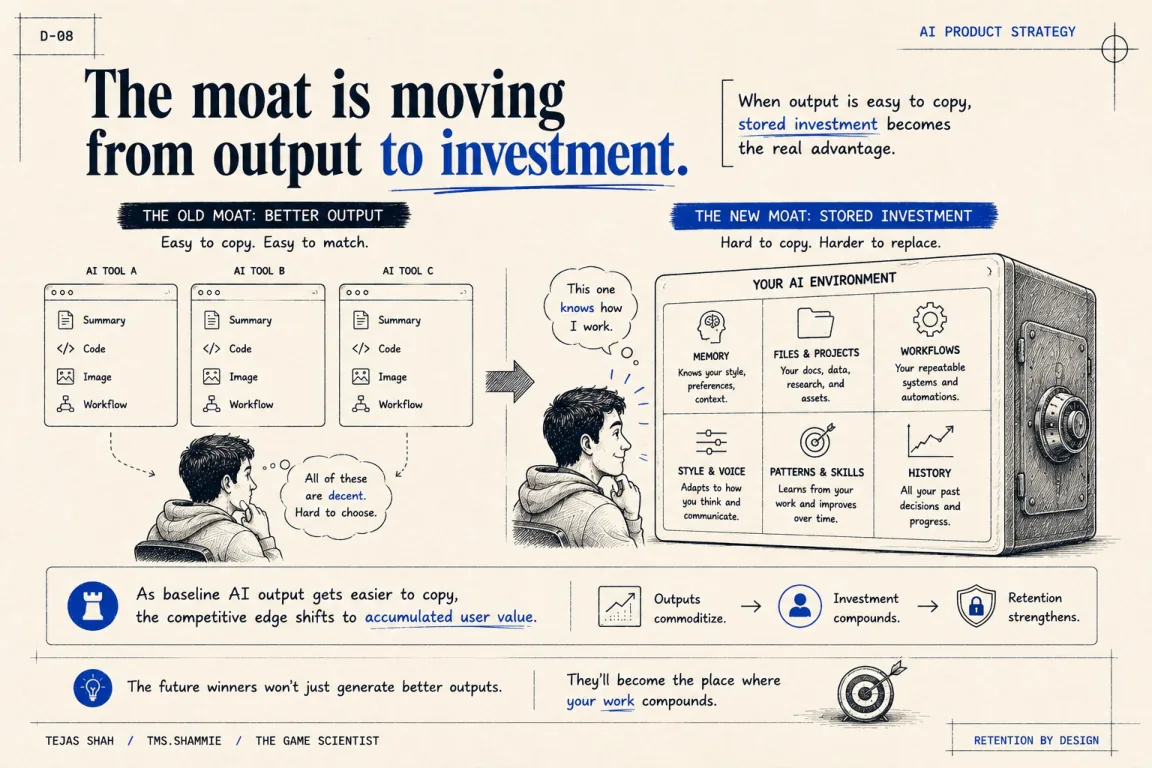
The economic logic here is not subtle. A stateless tool competes on capability. Every time a competitor ships an improvement, your retention advantage resets. If you’re not meaningfully better than the competition today, users leave.
A tool that accumulates context competes on history. To switch, the user has to give up what they’ve built. Their custom instructions. Their project context. Their documented workflow preferences. Their past conversations that the tool has learned from. The switching cost is not just inconvenience — it’s the loss of something they put work into.
This is the moat that games have always understood and that most AI products are only starting to discover. Once a product starts holding your context, leaving starts feeling like losing progress.
The product teams that recognize this earliest will build for accumulation from the start. They will treat the blank box as stage one of a longer architecture, not as the permanent design. They will instrument not just whether the user generated a good output today, but whether the product knows more about the user than it did last week. That rate of learning — how quickly the tool builds a useful model of each user’s context — is a metric almost no AI product is currently tracking. It is probably the most important one.
The product design test
The practical question for any team building a product past its first wow moment: if a user walked away today and came back in three months, would they feel like they’d lost something?
If the answer is no — if starting over is equivalent to picking up where they left off — the product has no progression to speak of. It has utility. Utility is easy to replace.
The alternative isn’t complex to describe, even if it’s hard to build: design the product so that continued use creates visible accumulation. Not cosmetic accumulation — functional accumulation. Context that compounds. Workflows that sharpen with repetition. A history that has value.
The WOW moment is now table stakes. The product category has trained users to expect it. What cannot be copied is the vault a user has spent six months filling. Magic gets the first try. Progression gets the second week — and everything after it.
If you’re thinking about this for a specific product, the Product Strategy Sprint is often where this conversation starts — specifically the gap between what the product currently measures (activation, output quality) and what would actually predict six-month retention.