Where Are Your Boss Fights?
Most products celebrate milestones. The best ones design moments where users earn the next level.
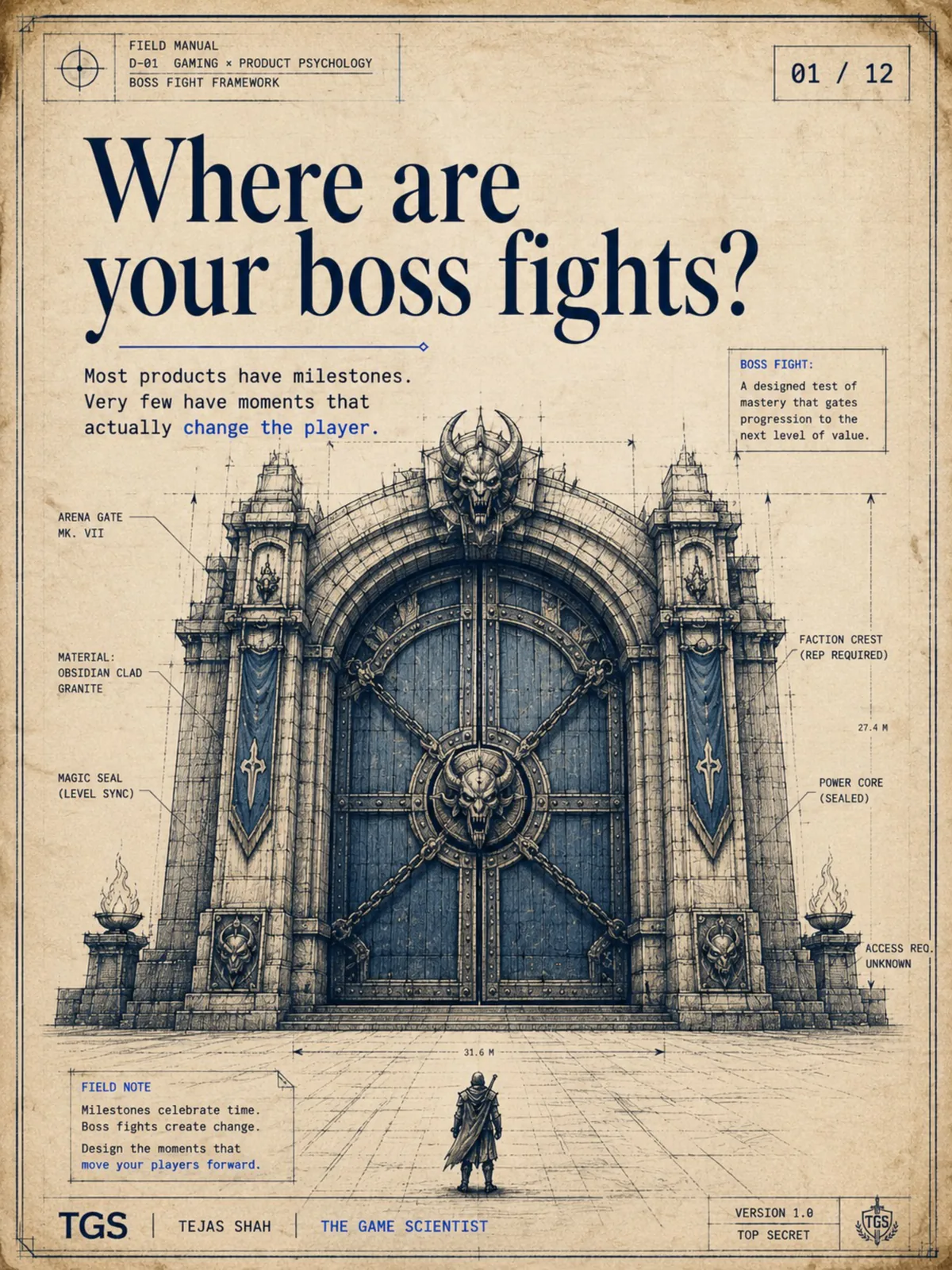
In games, the boss fight is the moment where the game stops quietly letting you progress and asks a harder question: can you actually use what you learned?
You cleared the smaller enemies. You learned the controls. You understood the pattern. You collected better tools. And then the game puts something bigger in front of you. That moment matters because it is a test. When the player clears it, the game is not just saying “congratulations.” It is saying: you earned the next level.
A boss fight has a specific mechanical function. It is a gate that validates accumulated competence before the next chapter begins. The player does not just move forward in the narrative — they prove to themselves that they are ready. That proof is what makes the progression feel earned rather than received.
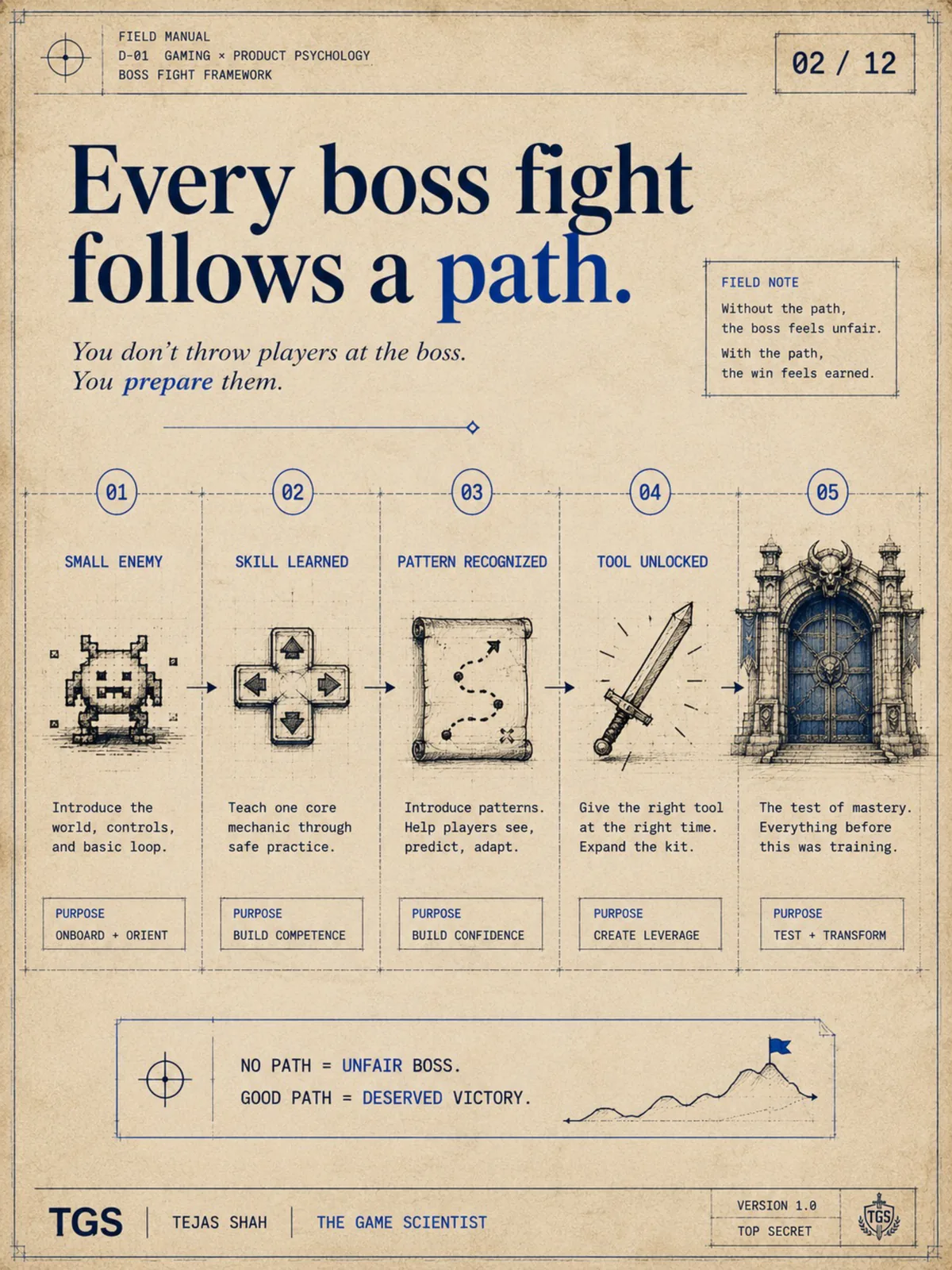
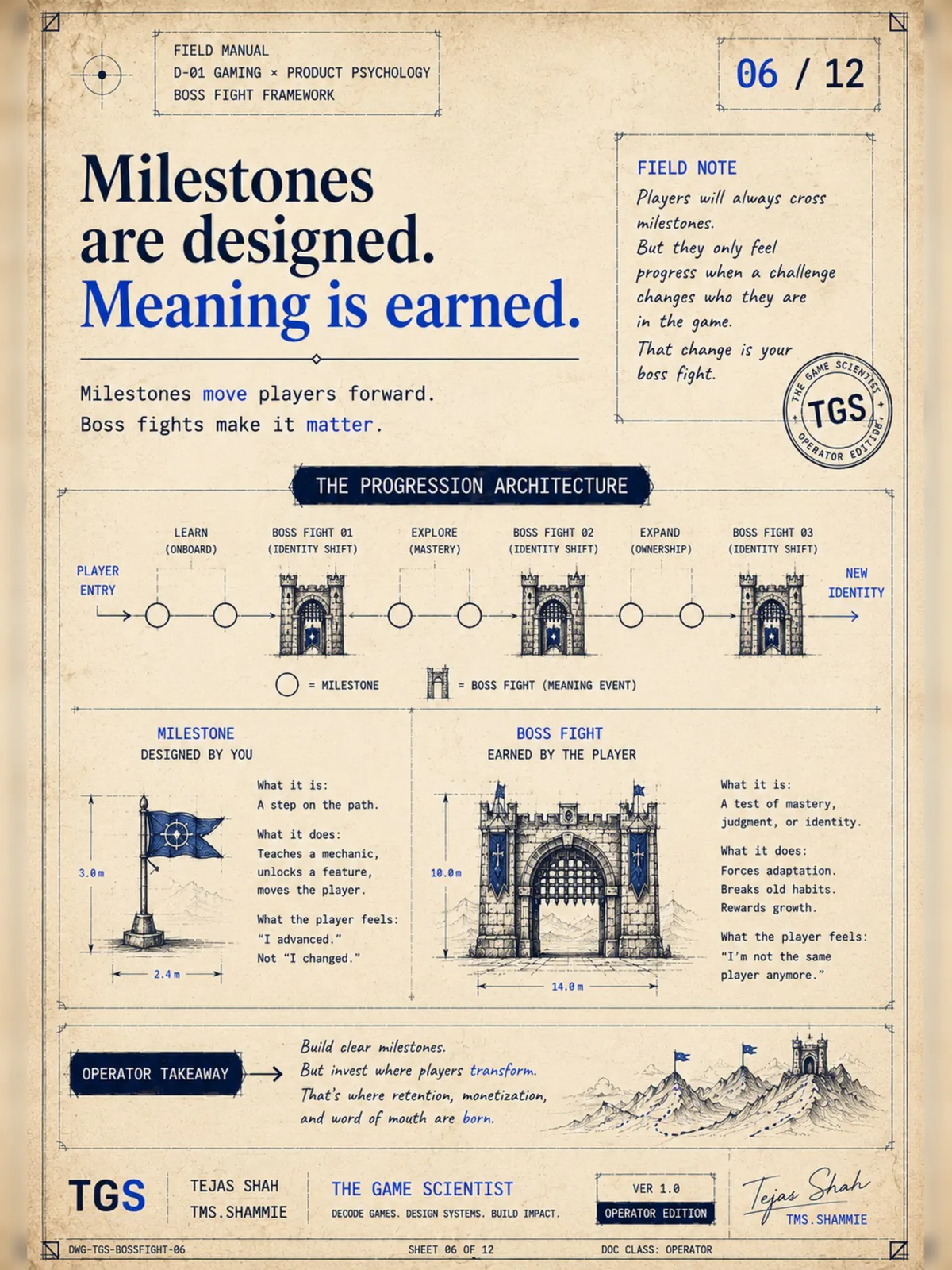
And crucially: a boss fight does not come first. It follows a path. Small enemies introduce the world and the basic controls. A skill gets taught through safe practice. A pattern gets introduced — the player learns to see it, predict it, adapt to it. A tool gets unlocked at the right moment. And then, with all of that accumulated, the test arrives. Everything before this was training.
Most products miss this entirely.
What products do instead
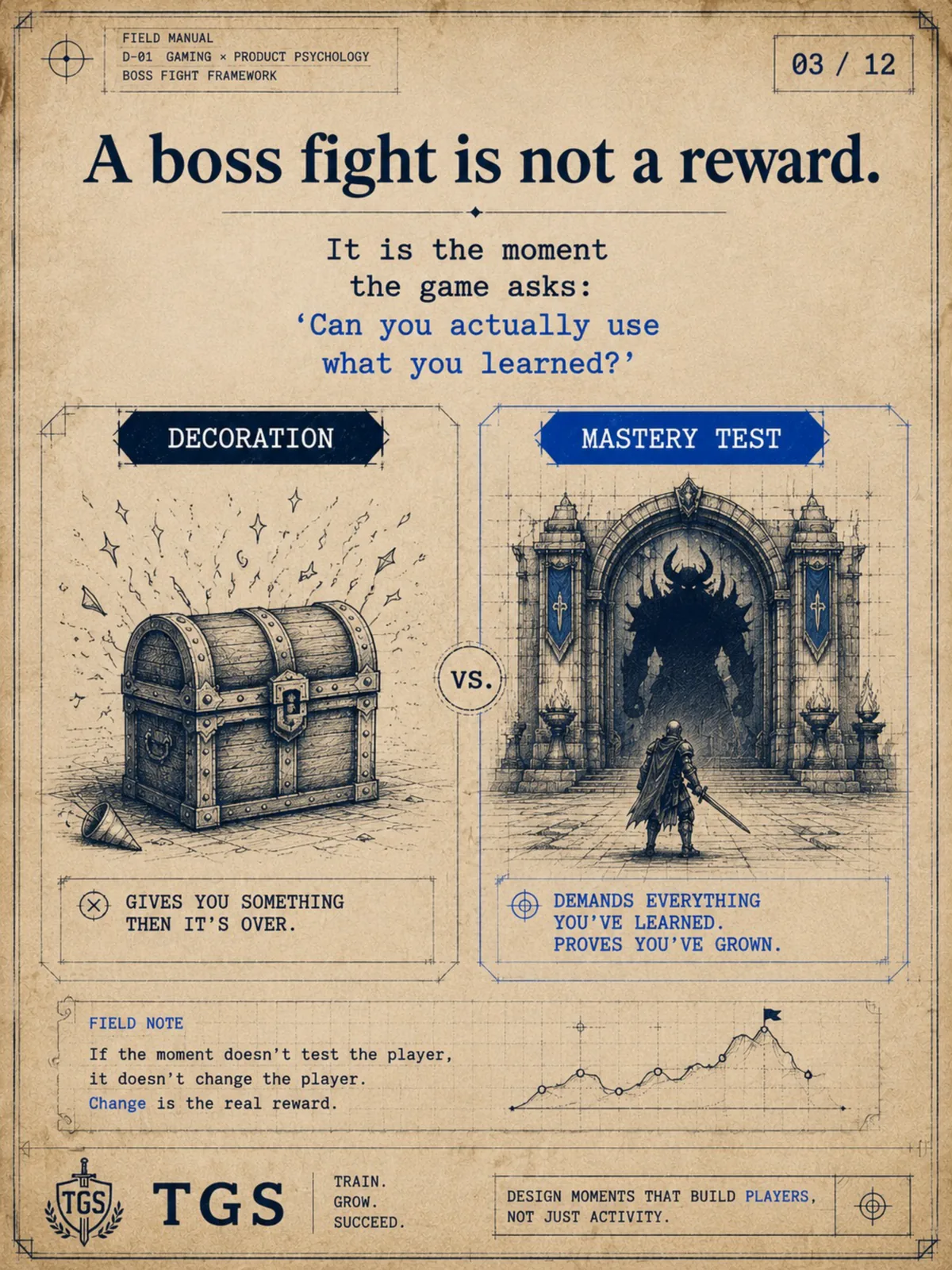
Products have milestones. What they do not have is boss fights.
First workout completed. First post published. First $1 earned. First dashboard shipped. First profitable campaign. These are genuine moments — the user did something that matters. But in most product designs, the event is treated as a notification rather than a test.
The system logs it. The user gets a push notification, an in-app celebration screen, or an email. If the design team was thoughtful, there’s a nice animation. If the team had extra time, there are confetti particles. The user taps dismiss and the flow continues.
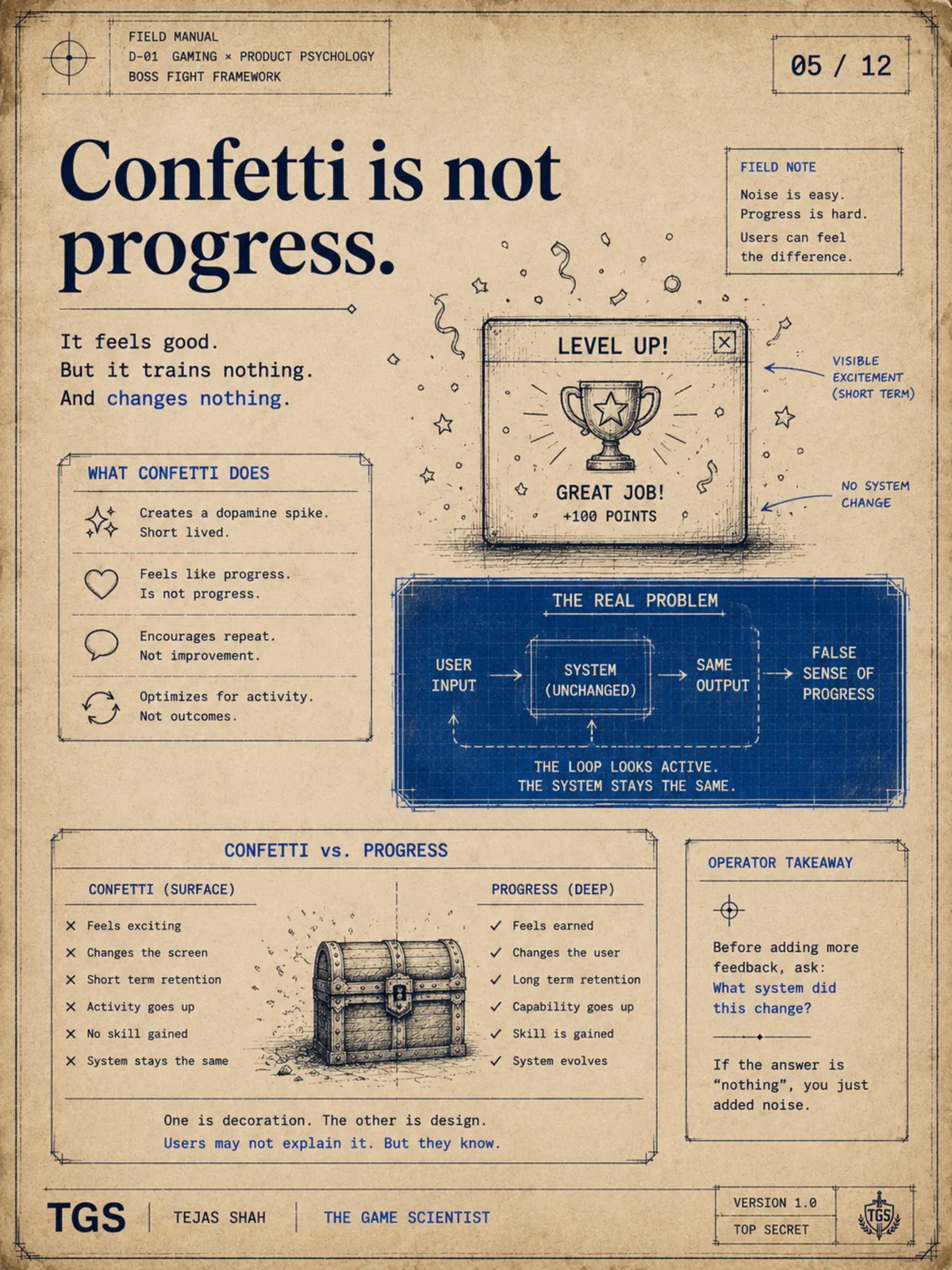
Here is the real problem with confetti: it creates a dopamine spike. It feels like progress. But it trains nothing and changes nothing. The product log recorded an event. It did not record what that event meant.
The event log sees activity. It does not see identity.
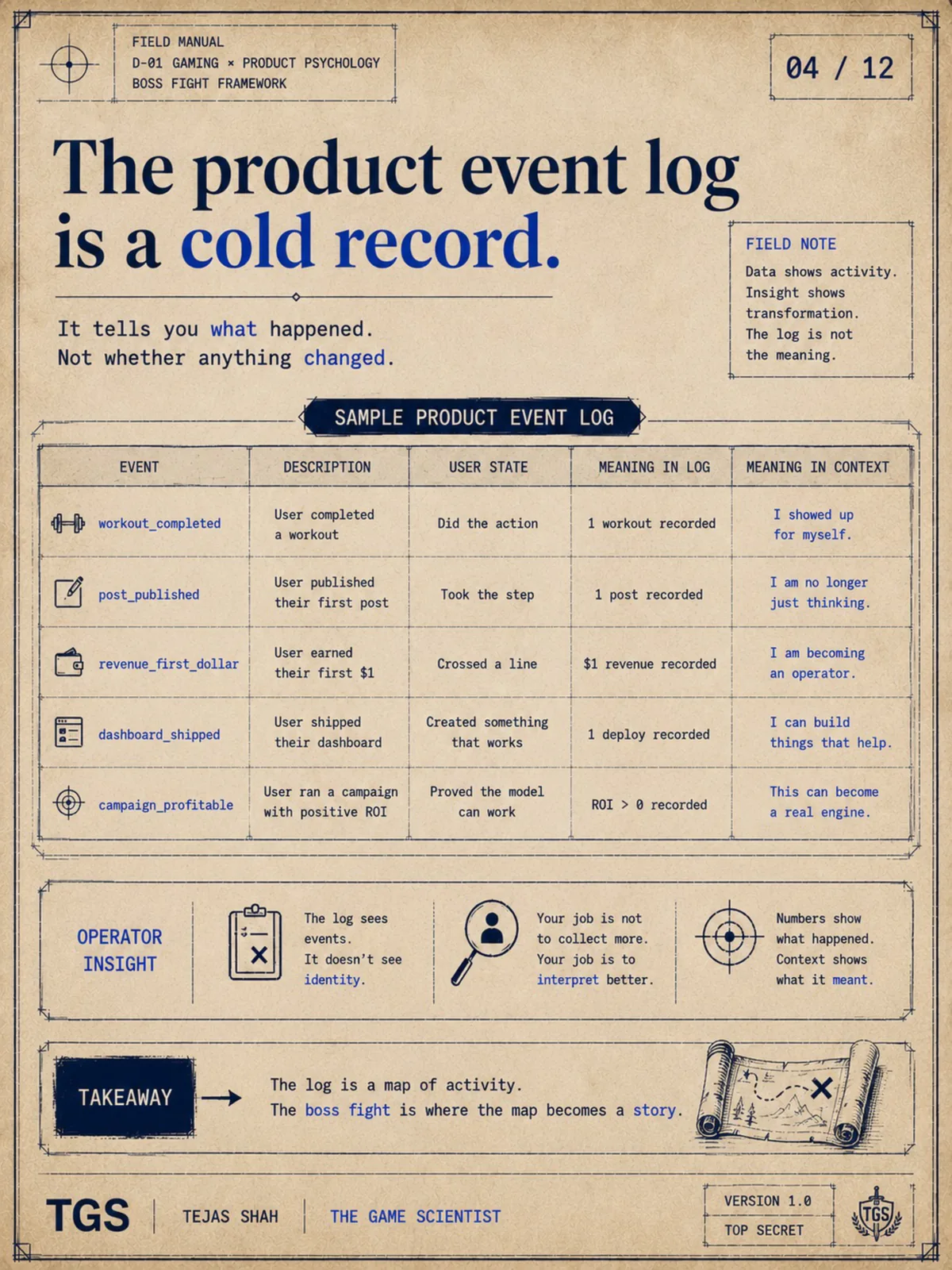
That distinction matters more than most product reviews acknowledge. Look at a product event log — workout_completed, post_published, revenue_first_dollar, campaign_profitable. Each is a data record. One workout counted. One post recorded. One dollar logged.
But from the user’s perspective, those same moments carry a different weight:
workout_completed→ I showed up for myself.post_published→ I am no longer just thinking privately.revenue_first_dollar→ I am becoming an operator.campaign_profitable→ This can become a real engine.
The log records activity. The boss fight creates transformation. Those are not the same thing, and the gap between them is where retention is actually won or lost.
Why this gap exists
The gap comes from two related design defaults.
The first is funnel thinking. Product teams are trained to minimize friction because friction shows up badly in funnel metrics. Lower completion rates, higher drop-off, more support tickets. The optimization instinct is always toward making things smoother, faster, and more forgiving.
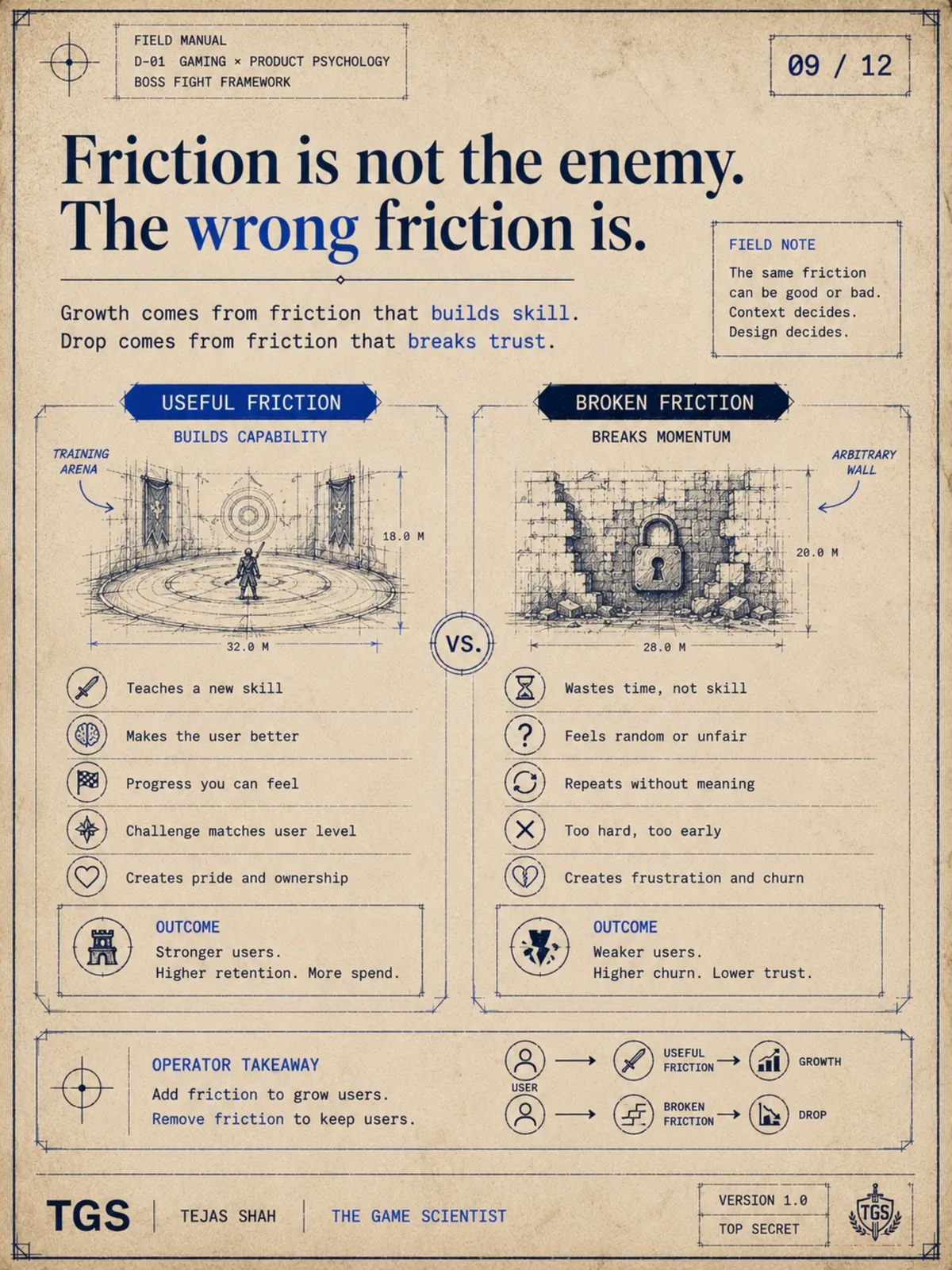
This is correct for friction that is genuinely wasted — effort that asks users to work without generating any value for them. But there is a meaningful distinction between useful friction and broken friction. Useful friction teaches a new skill, makes the user better, creates progress you can feel, and matches challenge to user level. It creates pride and ownership. Broken friction wastes time without building skill, feels random or unfair, repeats without meaning, or arrives too hard and too early. It creates frustration and churn.
Useful friction builds capability. Removing it does not improve retention — it lowers the perceived stakes, which reduces investment, which makes the product easier to leave.
The second default is milestone-as-reward design. Most teams think about milestones from a reward perspective: what do we give the user to celebrate this achievement? The question is correct but asked at the wrong point in the design process. The more important question — which usually never gets asked — is whether the milestone represents a genuine threshold that required something from the user, and whether clearing it changed how the user sees themselves in relation to the product.
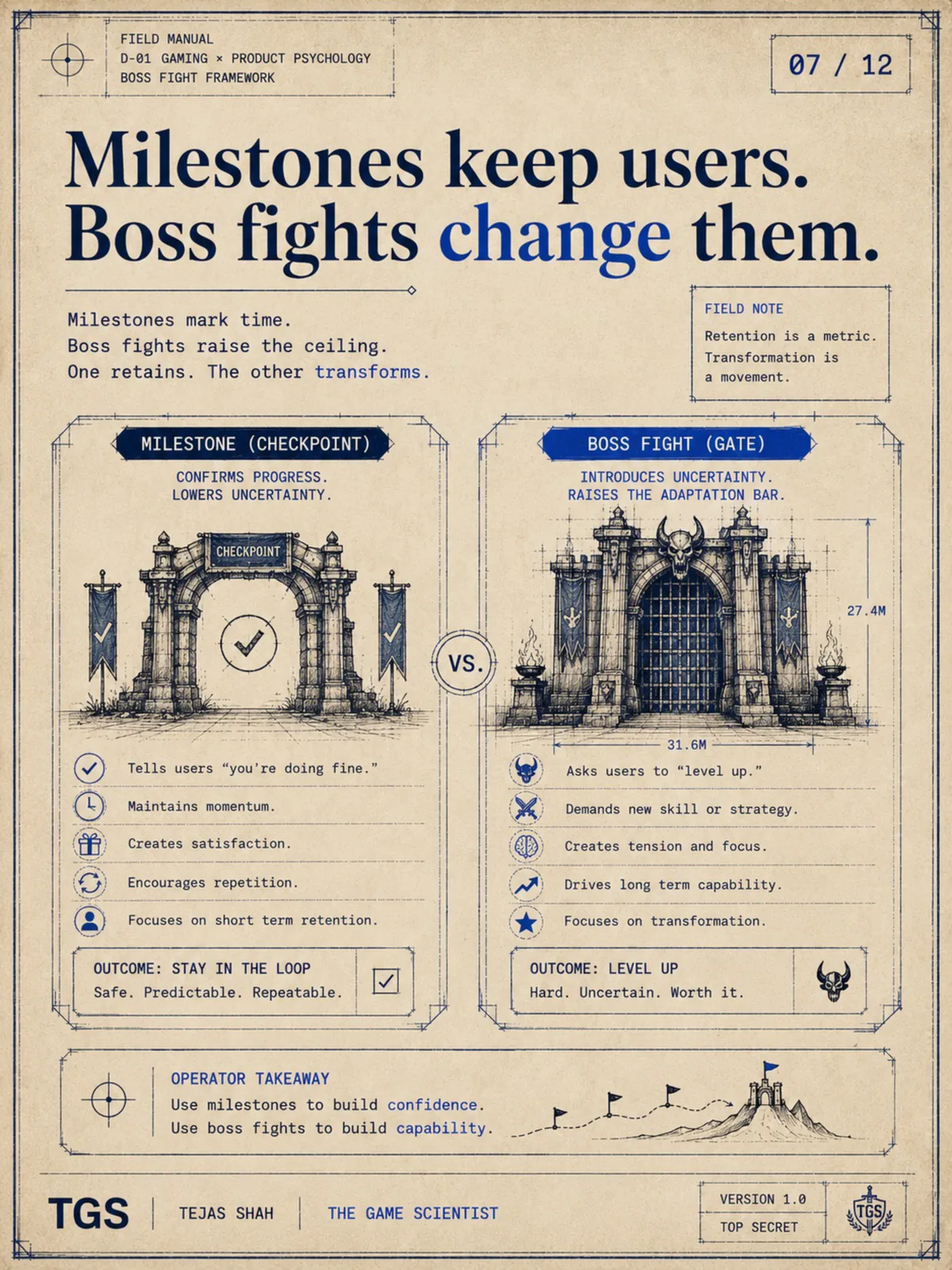
A passive checkpoint says: you reached this point.
An active gate says: you proved you’re ready for what comes next.
The difference is not small. One retains users. The other changes them.
What boss fight design looks like outside of games
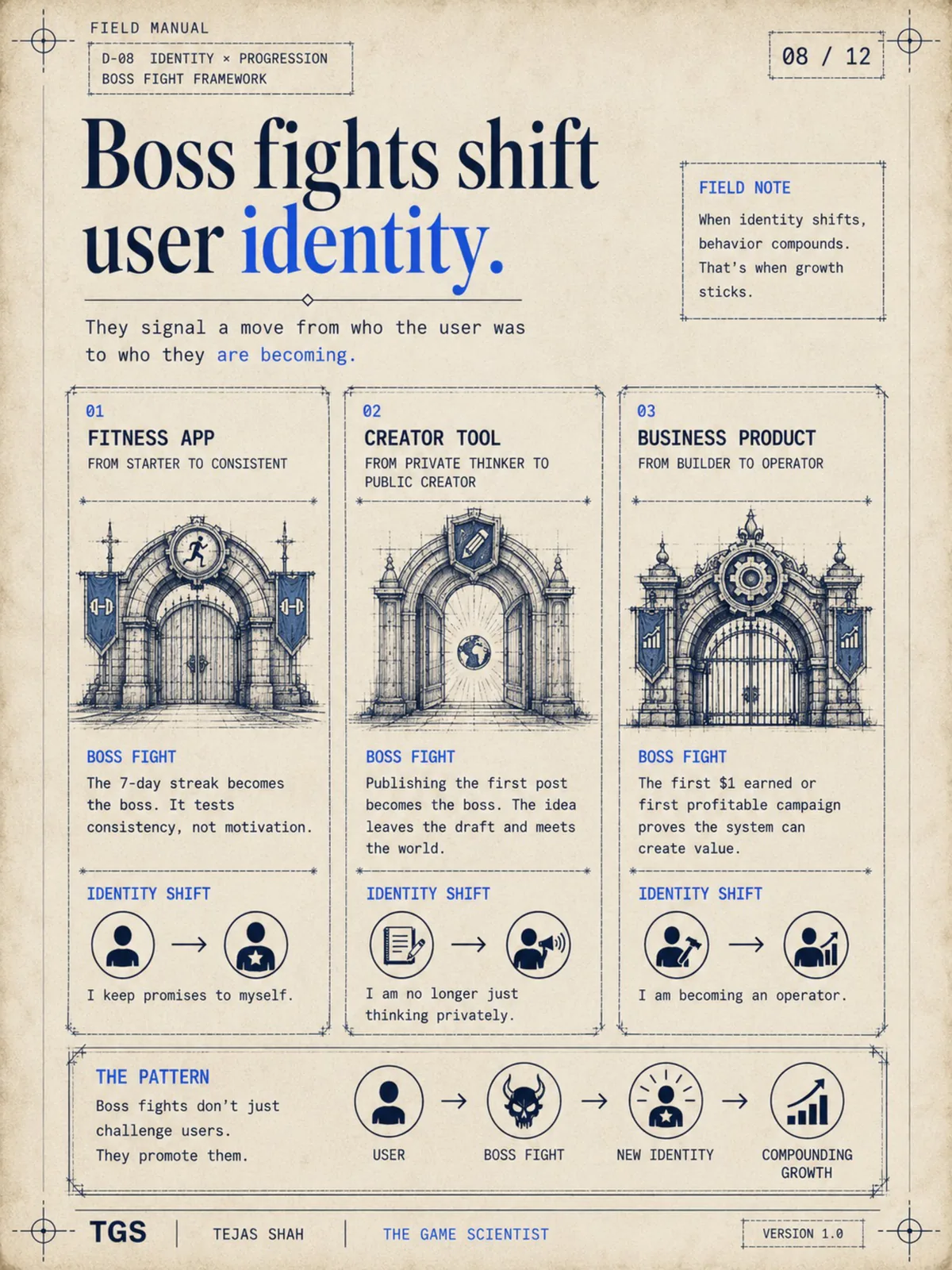
A fitness app that celebrates a 7-day streak is logging compliance. A fitness app that designs the 7-day session to be visibly harder than anything in the first six days — and that frames completion explicitly as “you can now train in ways you couldn’t a week ago” — is delivering a boss fight. The first validates that you showed up. The second validates that something changed. The user who clears the test carries a different identity: I keep promises to myself. That is the moment the product stops being a tool and starts being part of who they are.
A creator tool that confirms “post published” is logging an event. A creator tool that frames the first published post as the moment the user crosses from private thinker to public creator — with a design that marks the threshold deliberately, and makes it feel slightly more intentional than saving a draft — is turning a milestone into an identity shift. I am no longer just thinking privately. That is a different statement than “your post went live.” Users remember the one. They forget the other.
A business product that shows “first revenue generated” is displaying a metric. A product that designs that first revenue moment as a genuine threshold — with a specific frame around what it means, what it unlocks, and how the user’s relationship with the product changes — gives the user something to hold onto. I am becoming an operator. The first dollar does not just mean “this works.” It means “I am not the same person I was before this.”
These are not decoration decisions. They are retention architecture. Products that design these moments well have users who remember them — not because the feature was technically impressive, but because they remember when they earned something they did not have before.
Retention is a metric. Transformation is a movement. The products that compound the fastest are the ones where users feel the former is a byproduct of the latter.
The design question
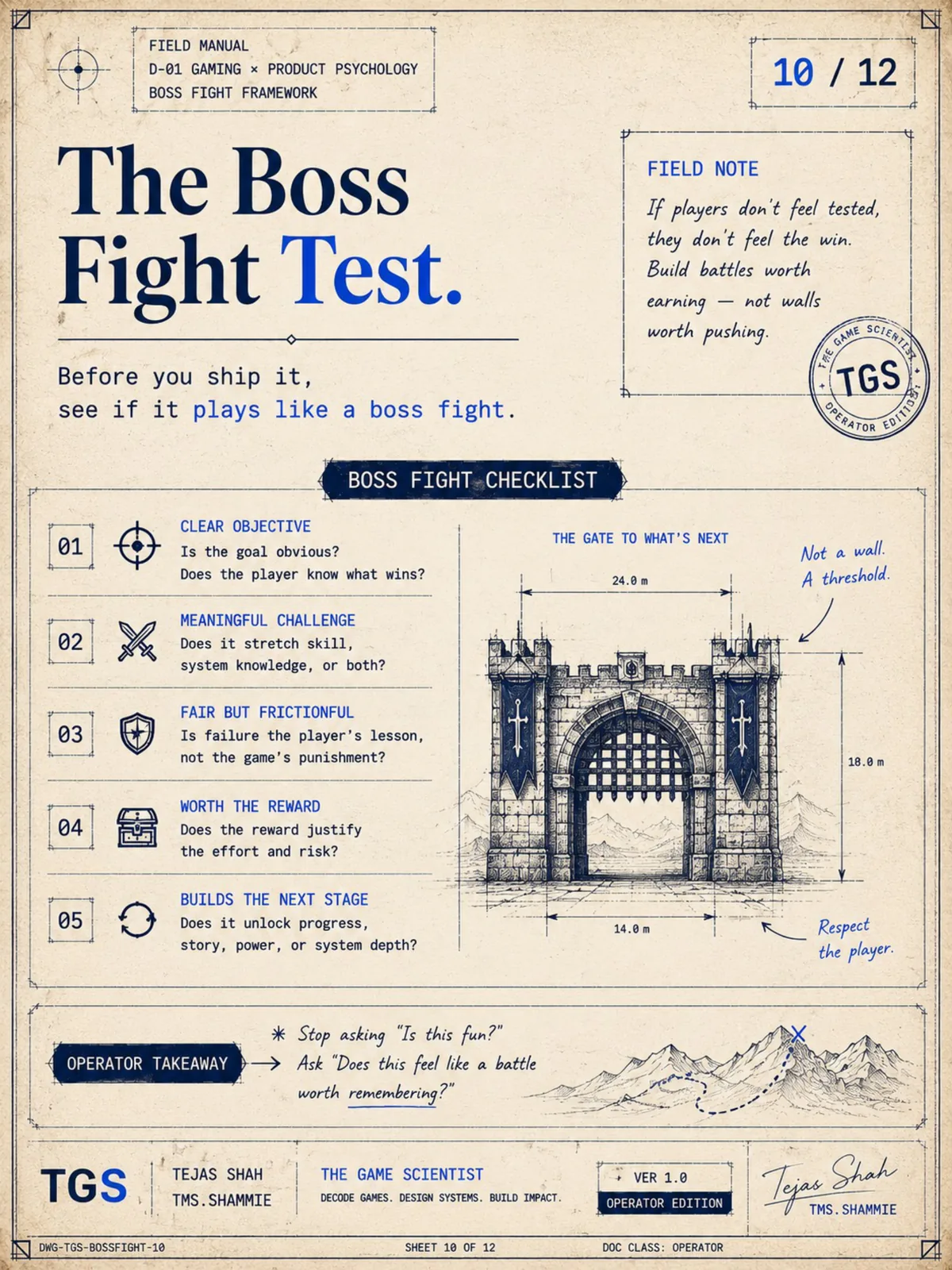
For any product with a structured progression, the productive design question is not “where can we add confetti?” It is: where does the user prove capability, intent, or identity — and does the product frame that moment as something earned?
The test is straightforward. Find the three to five milestones in your product where user behavior is fundamentally different on one side of the milestone than the other. The sessions before it are qualitatively different from the sessions after — different patterns, different depth, different goals. Those are your natural boss fight locations.
Then ask two things. First: is the product treating those moments as passive checkpoints or active gates? Second: would they still feel meaningful if all the confetti, push notifications, and celebration screens disappeared?
If the answer to the second question is “probably not” — the milestone has been decorated, not designed. The design question is whether you’re treating those moments as passive checkpoints or active gates.
A passive checkpoint says: you reached this point.
An active gate says: you proved you’re ready for what comes next.
One is a participation trophy. The other is a reason to stay. Players don’t remember that you blocked them. They remember the moment you let them become something stronger.
When I do Product Strategy Sprint work, the boss fight audit — identifying which milestone events represent genuine behavioral thresholds versus cosmetic celebrations — is usually where the most interesting retention levers appear. It is almost always a short list, and the interventions are rarely about adding more. They are about treating existing milestones with the weight they actually deserve.
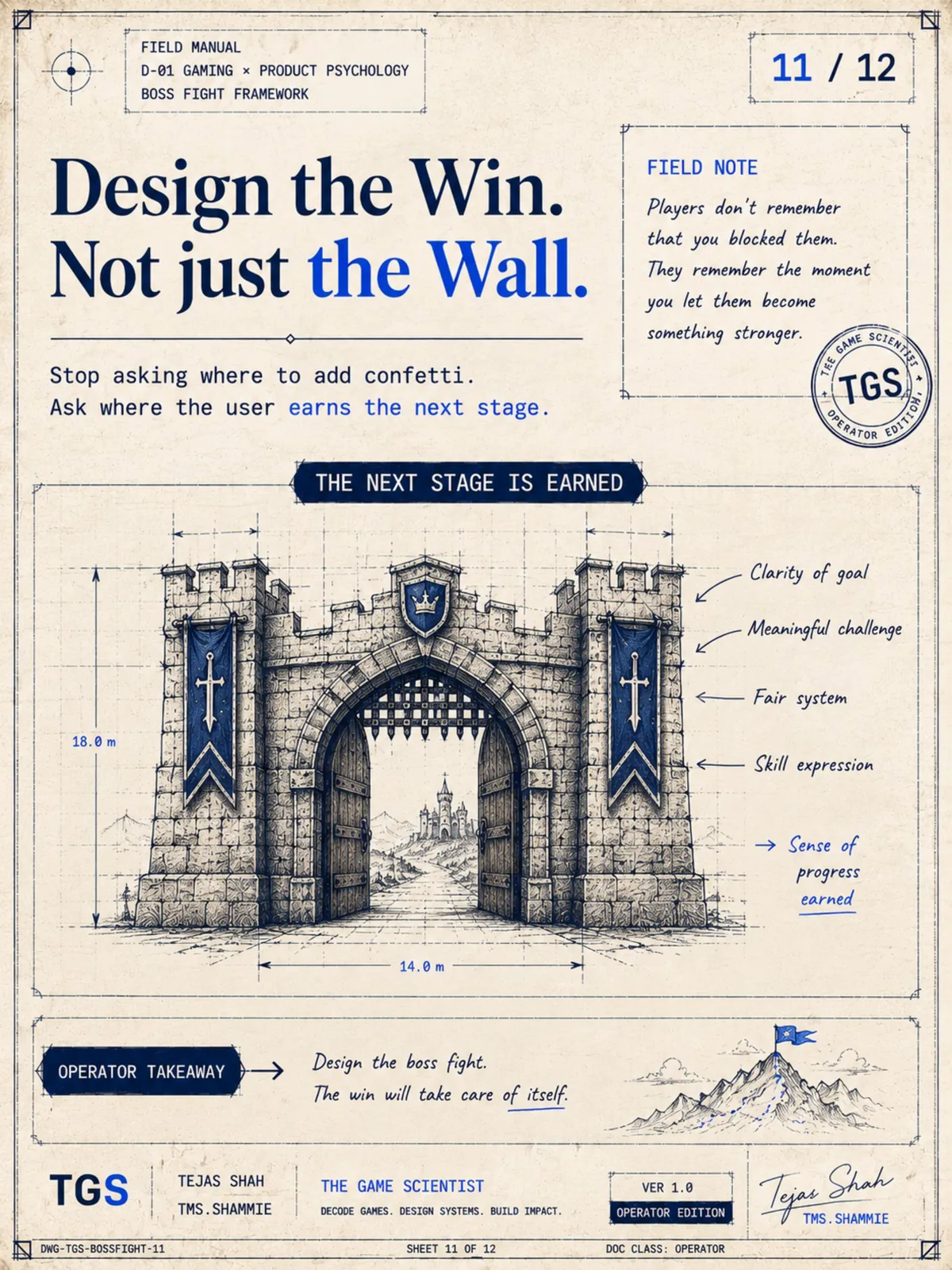
Design the boss fight. The win will take care of itself.