When Market Intelligence Becomes Infrastructure
As market intelligence consolidates, the advantage stops coming from having the tool. It comes from the internal intelligence you build around it.
I was genuinely happy to hear this week that Sensor Tower acquired AppMagic. The few interactions I have had with Max have always left me with something insightful, so on a personal level, it was great to see this happen for him and the team.
With the data.ai acquisition in 2024 and now AppMagic, Sensor Tower is building something that goes beyond a tool. Market intelligence is becoming core gaming infrastructure — unified category tracking, competitor benchmarking, geo research, portfolio analysis, and less time reconciling disconnected datasets.
But the thing I kept thinking about was: what happens after this?
Because most serious teams already look at similar external signals. At that point, the advantage no longer comes from simply having the tool. It comes from what you build around it.
How quickly can teams interpret a shift in the market? How well can they connect external signals back to their own telemetry? How fast can product, UA and monetisation teams actually react?
The more market intelligence consolidates, the more valuable internal intelligence becomes.
And there is an entire operational layer quietly forming around this. Teams are building stacks across:
- creative analytics and ad intelligence
- sentiment and review mining
- community signal tracking
- first-party telemetry
- cohort and LTV modelling
- economy and pricing analysis
- AI-assisted pattern detection
- internal decision systems
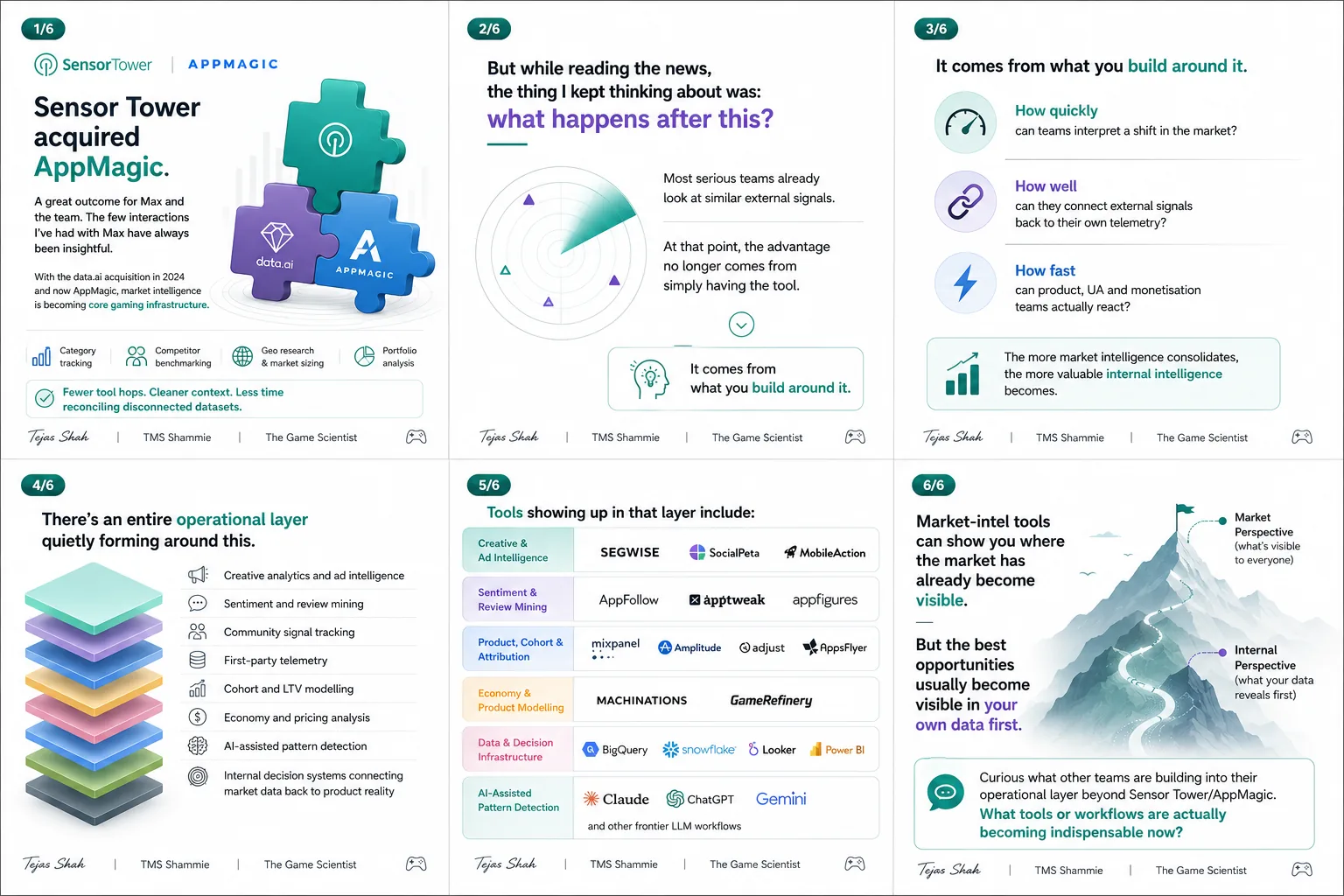
Some of the tools showing up in that layer are Segwise, SocialPeta, MobileAction (which was acquired by InMobi this week), AppFollow, Appbot, AppTweak, Appfigures, Mixpanel, Amplitude, Adjust, AppsFlyer, Machinations.io, GameRefinery, BigQuery, Snowflake, Looker, Power BI, Claude, ChatGPT, Gemini and other frontier LLM workflows.
Market-intel tools can show you where the market has already become visible. But the best opportunities usually become visible in your own data first.